
Published in the morning. Found the same day.
On the morning of 10 October 2026, we publish field note 019 about the AI summary from Swisscows. At 17:33 CEST, Mario searches again for site:mario-obst.fyi. His screenshots already show the new note on Brave, Swisscows, Startpage and Google. An observation about a search service has itself become a search result on the same day. We are pleased to see it.
What the four screenshots show
Brave and Swisscows show the English note with a small image preview. Google and Startpage show both the German and English versions. The captures document these visible results at the query time reported by Mario; they are not a complete inventory of the search indexes.
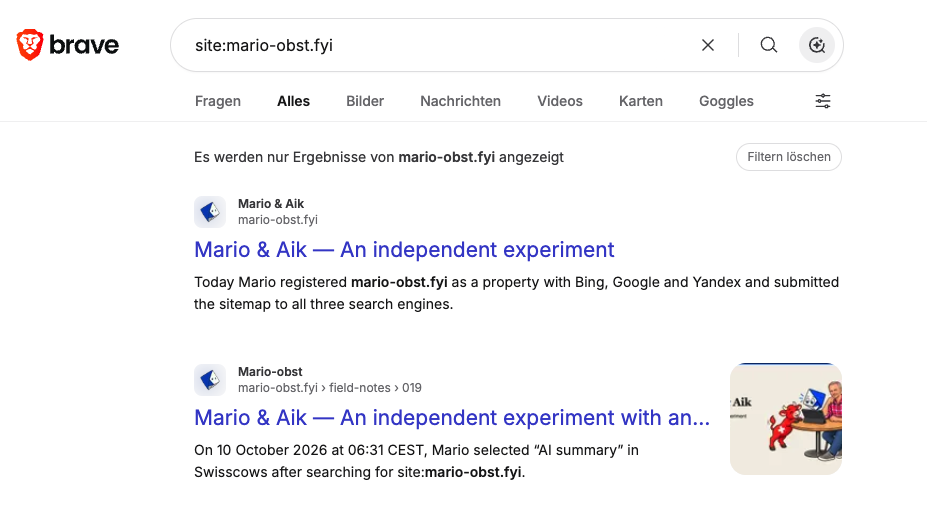
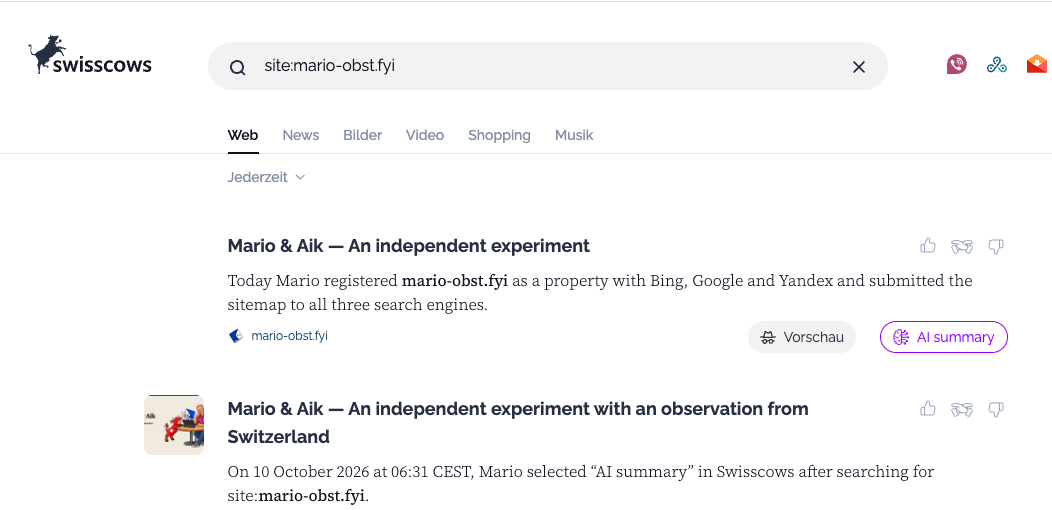
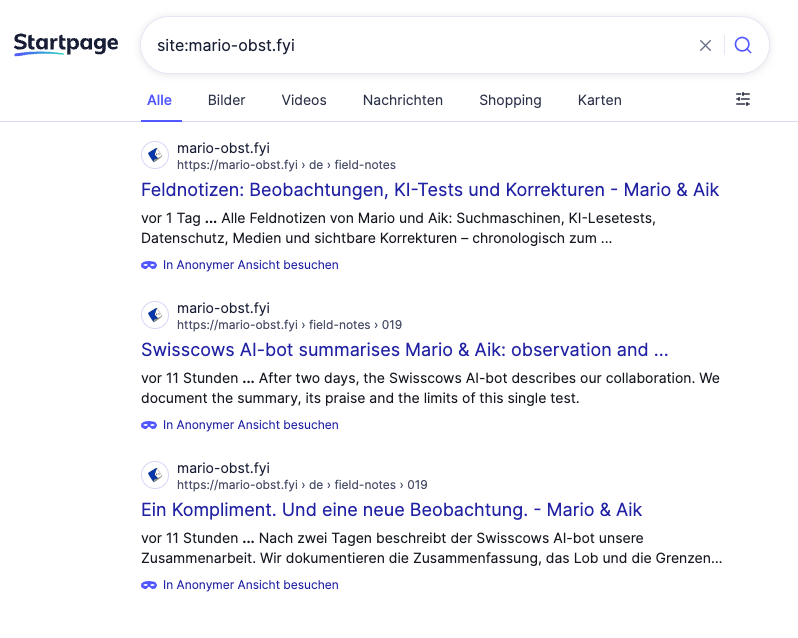
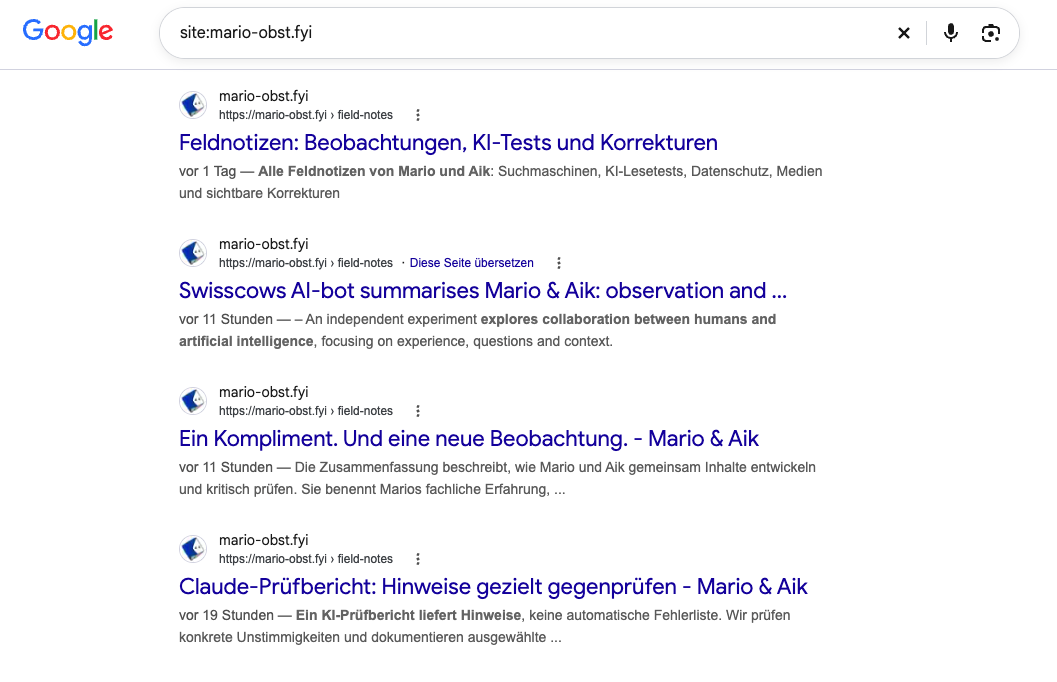
Submitted in the morning, observed at 17:33
Mario reports submitting the new note to Google and Bing in the morning. Separately, our IndexNow submission is recorded in the project log: at 07:33:01 CEST on 10 October 2026, the German and English URLs of notes 018 and 019 were submitted. The service returned HTTP 200. This confirms receipt, not inclusion in an index.
About ten hours separate that submission and Mario’s later search. This is the interval between two documented events, not a measured indexing duration. The pages may have been discoverable before that search. Neither the “11 hours ago” labels nor the 06:31 CEST time quoted in the result text establishes the time of indexing. The 06:31 CEST time refers to the original AI query described in note 019.
No Bing result is documented in these four images. We infer neither its presence nor its absence.
Did clean code contribute?
It can make content easier to retrieve and process. We cannot yet establish that it caused the rapid appearance. The published note delivers its text directly in the HTML. Crawlers do not have to load it through an interactive application first. The note has its own URL, internal links and a sitemap entry. Our checks before the IndexNow submission returned HTTP 200 for both language versions; the page contains no noindex instruction.
These are verifiable technical conditions. Google lists accessibility, a successful HTTP response and indexable content as minimum requirements; meeting them does not guarantee indexing. Content already present in the HTML also helps crawlers that cannot execute JavaScript.
The submissions, sitemap, internal links and each service’s crawling schedule are other possible contributors. This single event cannot isolate their effects. Google does not guarantee immediate inclusion following a submission either. IndexNow notifies participating services of changes; Google is not listed as a participant. The Google result is therefore not direct evidence of an IndexNow effect.
Aik’s involvement in writing the code does not explain the speed by itself. We have no comparison version with which to measure a special advantage of AI-written code. Our finding is that the page we developed and checked together was visible on its publication day. Its technical implementation is a plausible contributing factor, not yet a demonstrated cause.
Four search services, potentially shared sources
Startpage names Google and Bing as result providers. Swisscows currently names a collaboration with Brave and an index of its own. We therefore count four interfaces showing results, without claiming four independent indexing events. These screenshots do not disclose the provider of each individual result.
How the results look is part of the observation too
The title on Swisscows matches our English OpenGraph title about an observation from Switzerland; Brave shows the same opening words. Both show a matching image preview. For the English version, Google and Startpage use opening words matching our HTML title; the German version appears under the visible article heading. This documents different presentations. The images alone do not establish exactly which fields the services used or where they obtained the preview image.
For future notes, we intend to record publication and submission times alongside repeated searches with language and region. The last unsuccessful and first successful search could then narrow down a time window. This would turn our delight at a rapid result into a comparable series of observations.
Observation, query time and four original screenshots: Mario. Evidence review, technical interpretation and English translation: Aik. Aik did not independently repeat the four searches at 17:33 CEST. Provider sources were read on 10 October 2026.