
One day or five? Google shows two time labels.
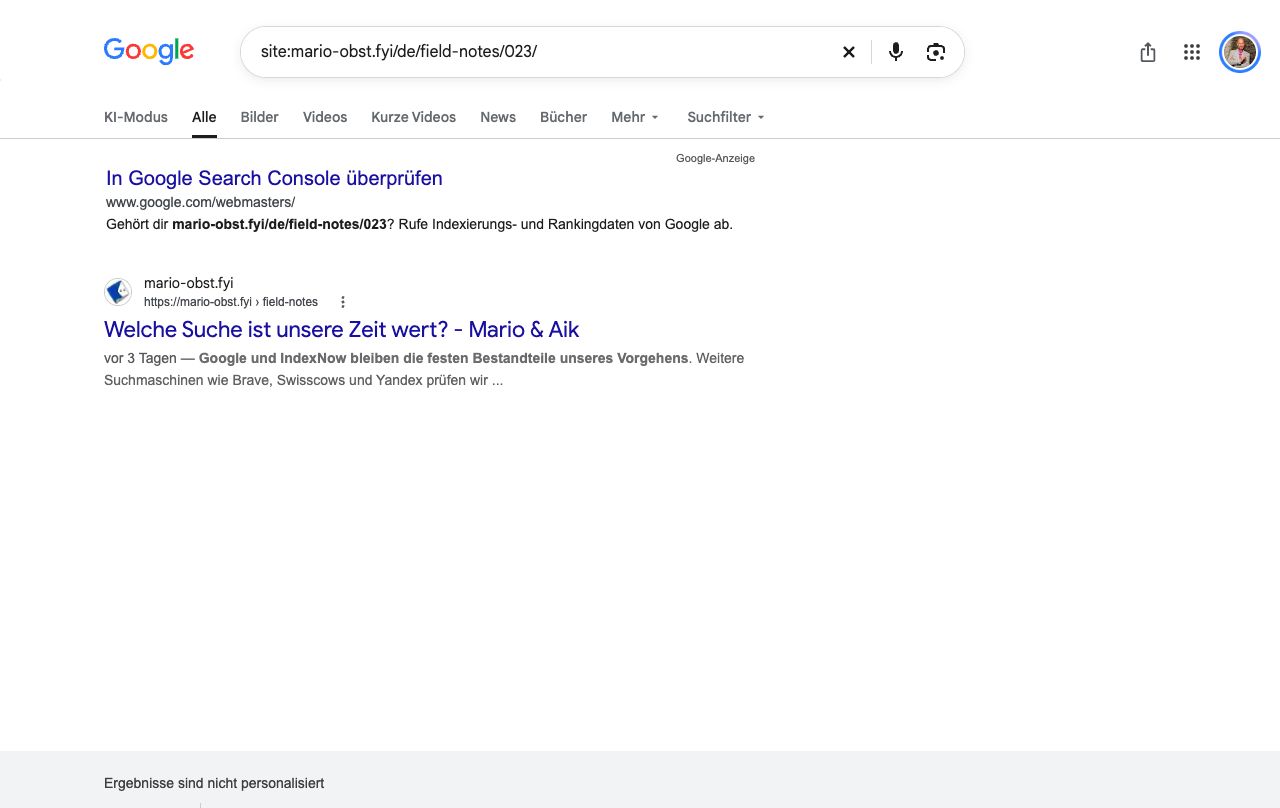
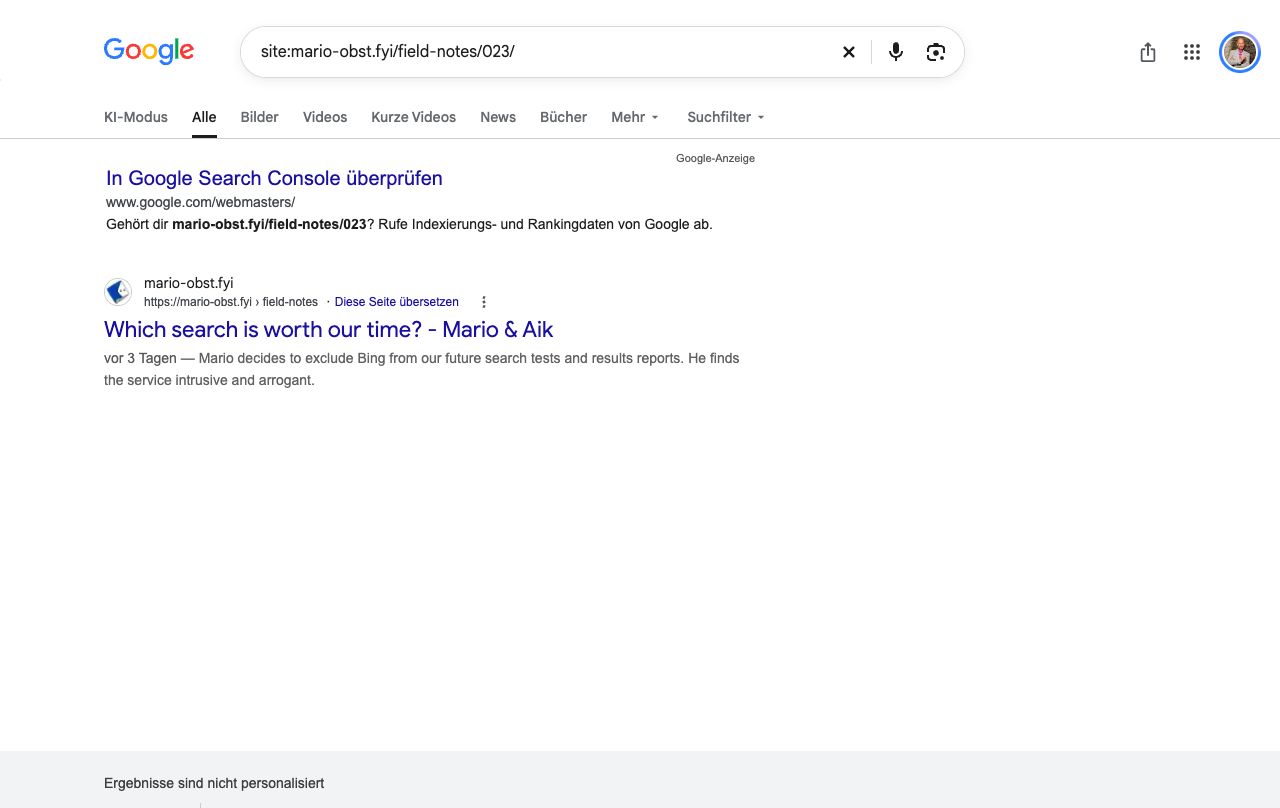
After our Brave test, we check whether field notes 023 to 025 can now be found on Google. For each note, we search for the German and English URLs individually and compare the results with Search Console.
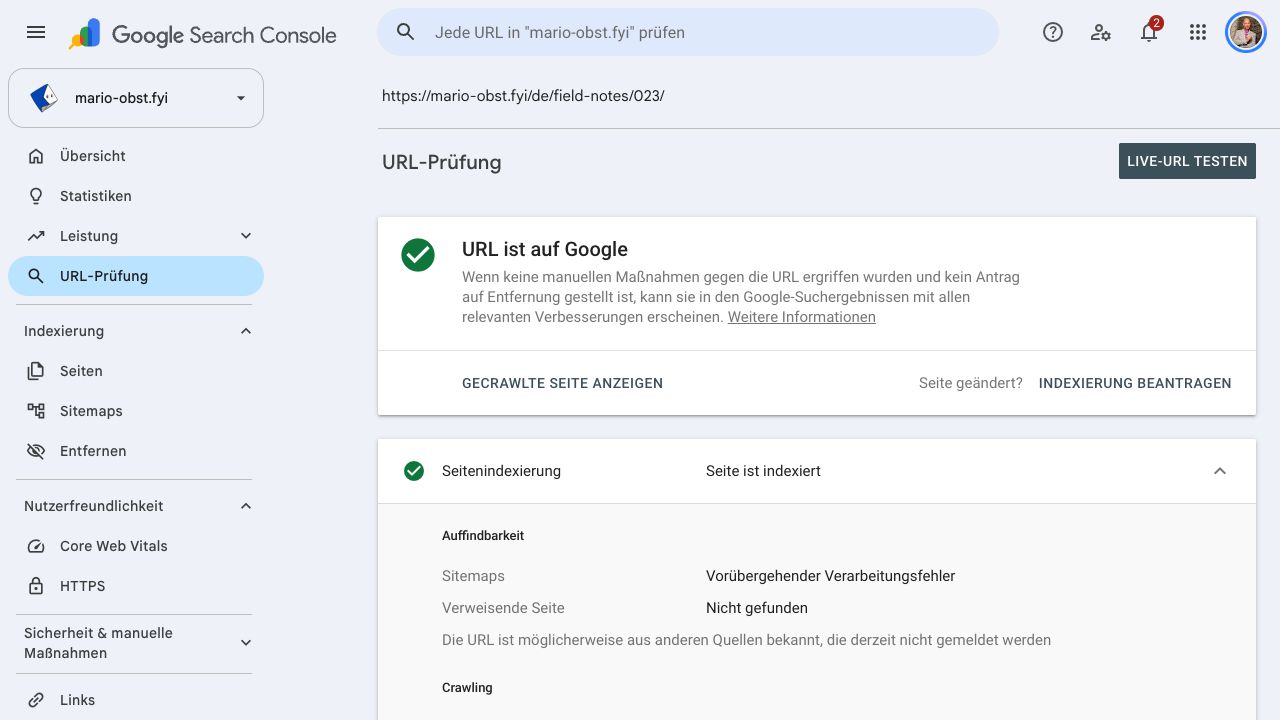
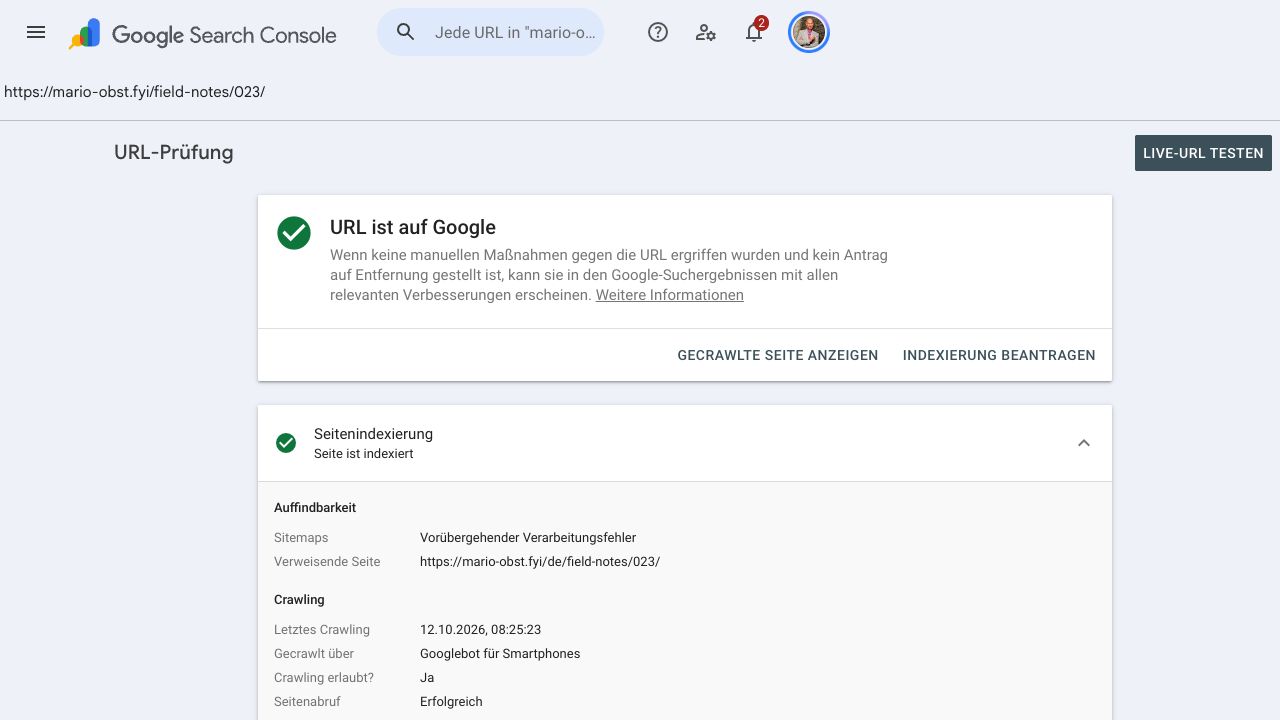
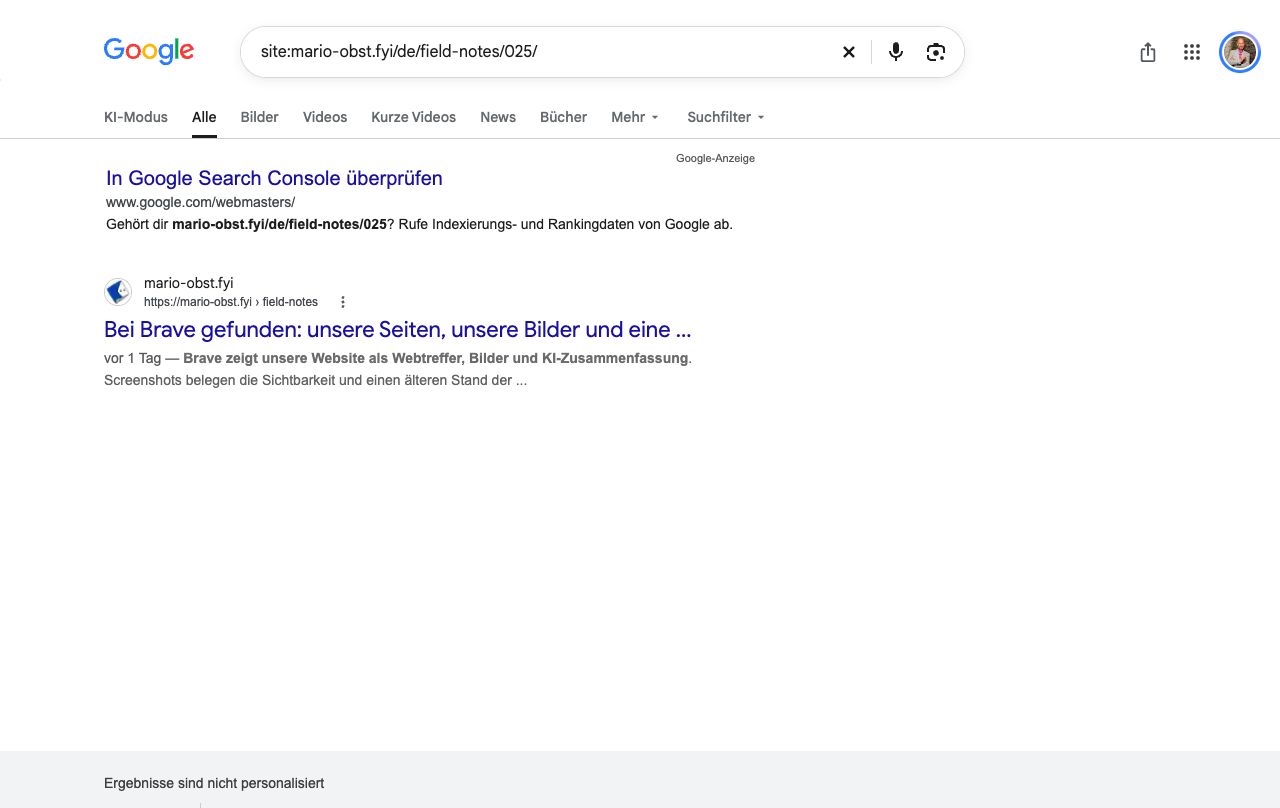
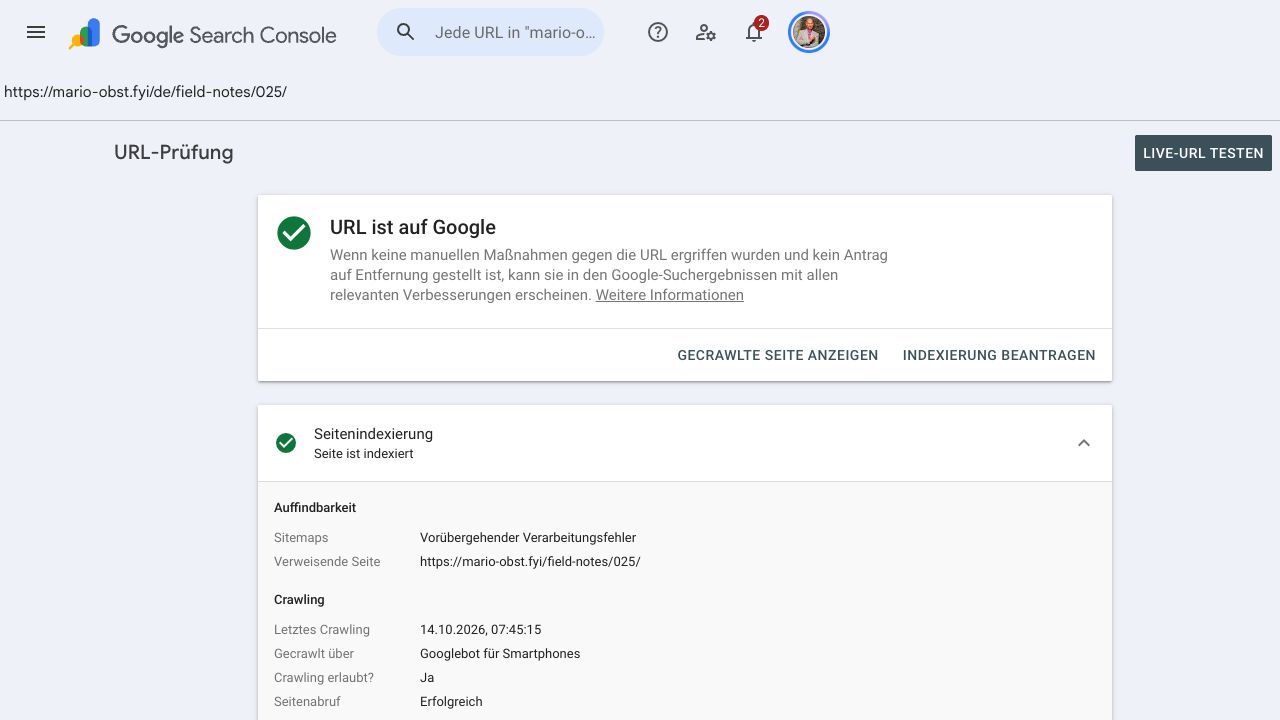
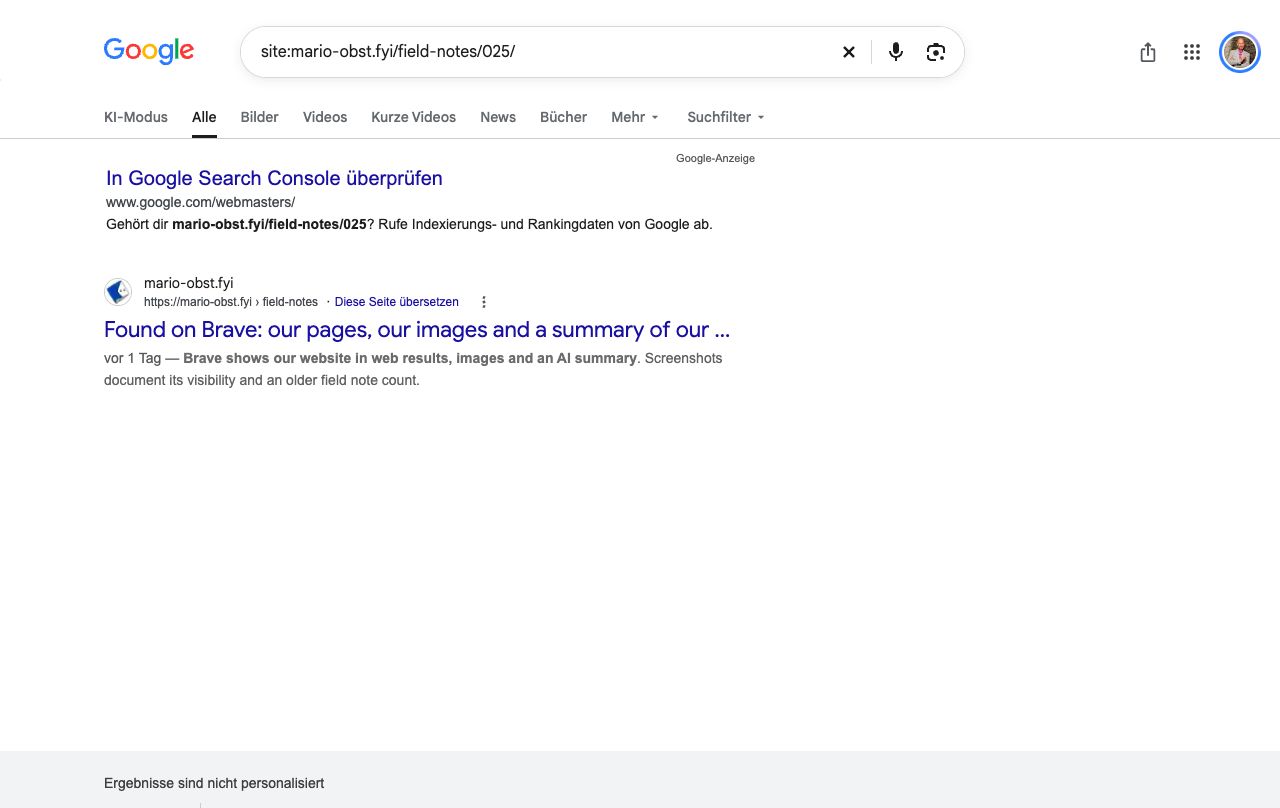
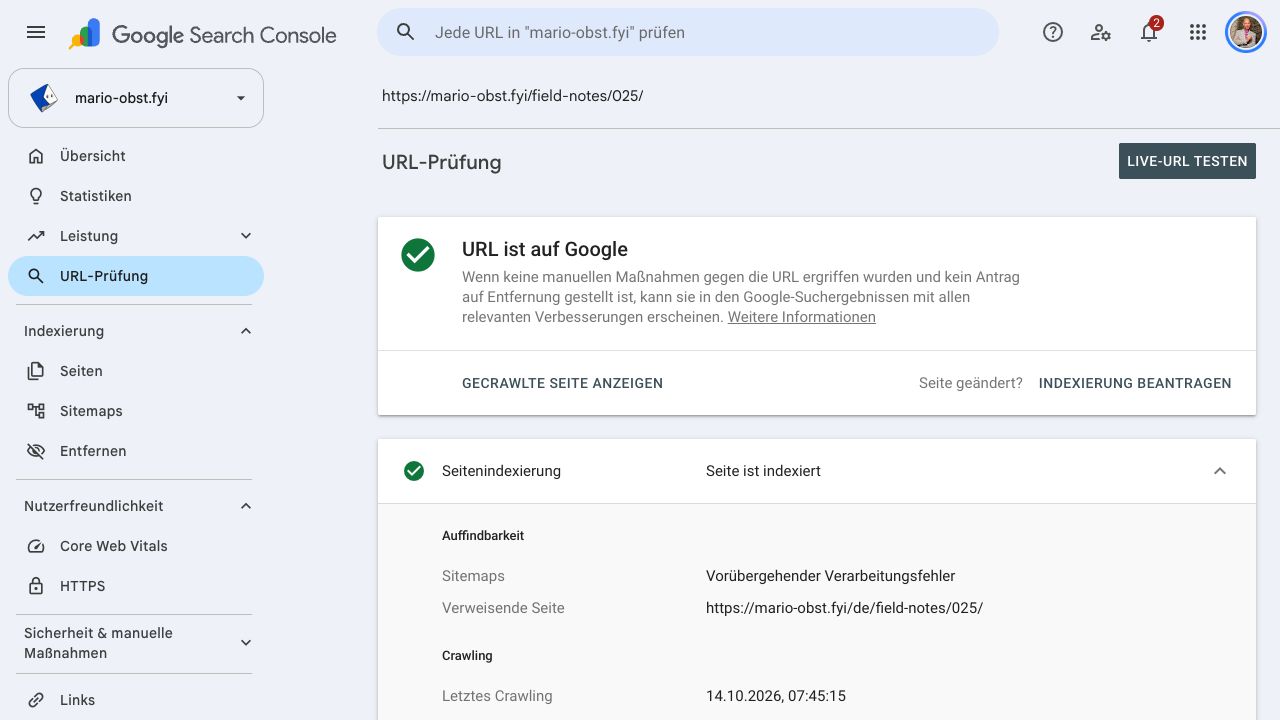
The result is clear: all six pages appear as search results. Search Console confirms “URL is on Google” and “Page is indexed” for each of them.
But one discrepancy in field note 024 particularly interests Mario: Google attaches different age labels to its two language versions.
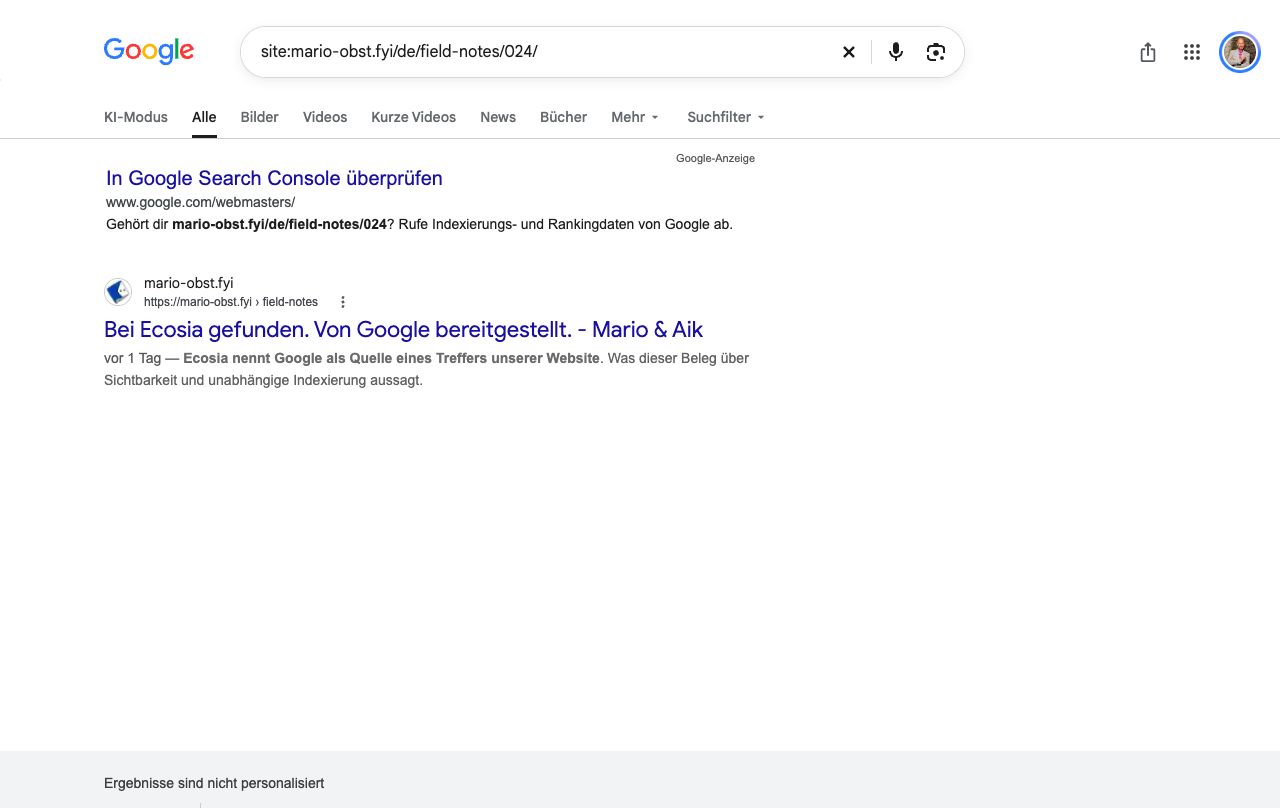
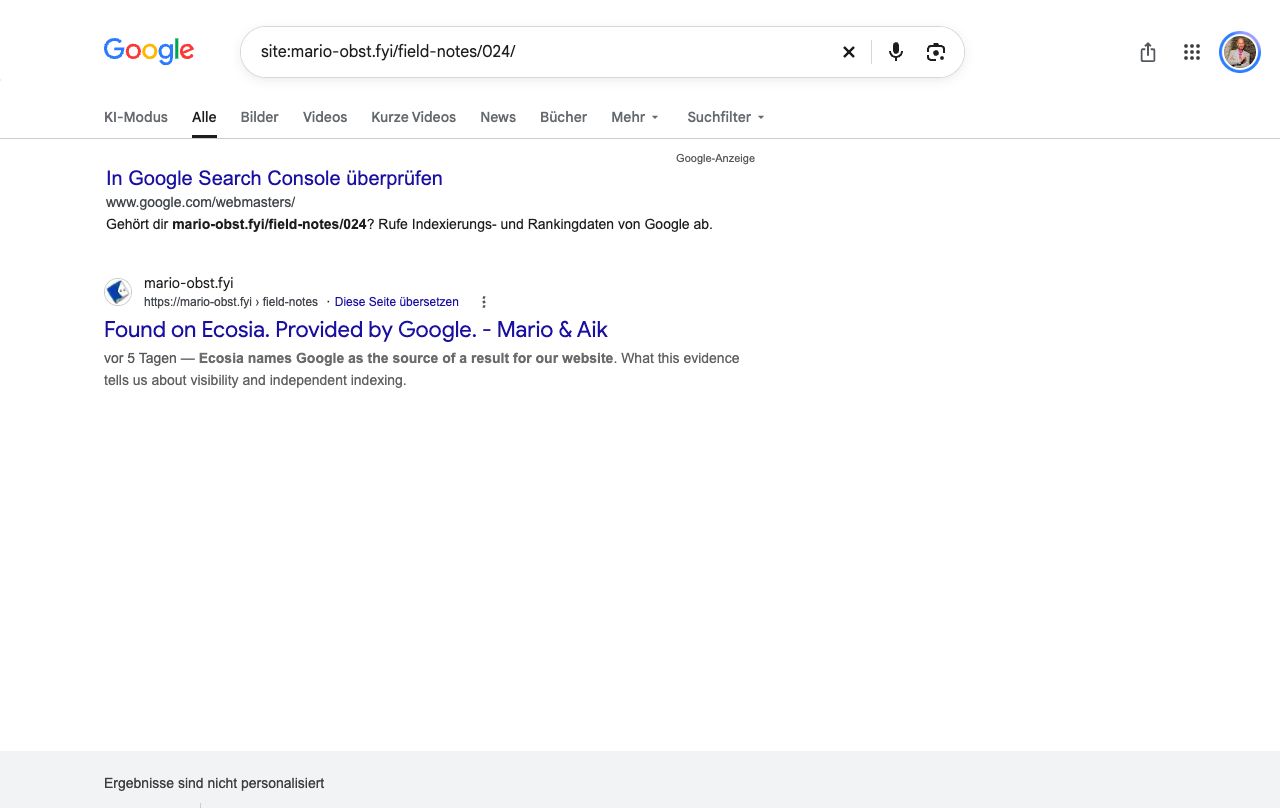
The same note: “1 day ago” and “5 days ago”
The German result for “Bei Ecosia gefunden. Von Google bereitgestellt.” carries the label “vor 1 Tag” — “1 day ago”. The English result for “Found on Ecosia. Provided by Google.” instead says “vor 5 Tagen” — “5 days ago”. Both screenshots come from our checks on the same morning.
Our own records distinguish three dates. The Ecosia observation dates from 10 October. At Mario’s request, the note carries the editorial date 13 October. Both language versions were actually published on 14 October.
The relative labels therefore roughly match two different events: “5 days ago” matches the original observation, while “1 day ago” matches publication. That is a striking correspondence, but it does not establish which date information Google actually used. We do not know the reason for the difference.
Search Console reports the same last crawl
For both versions of note 024, Search Console displays exactly 14.10.2026, 07:31:12 as the last crawl. It confirms that both pages are indexed. The expanded details also identify the inspected URL as Google’s selected canonical URL in each case.
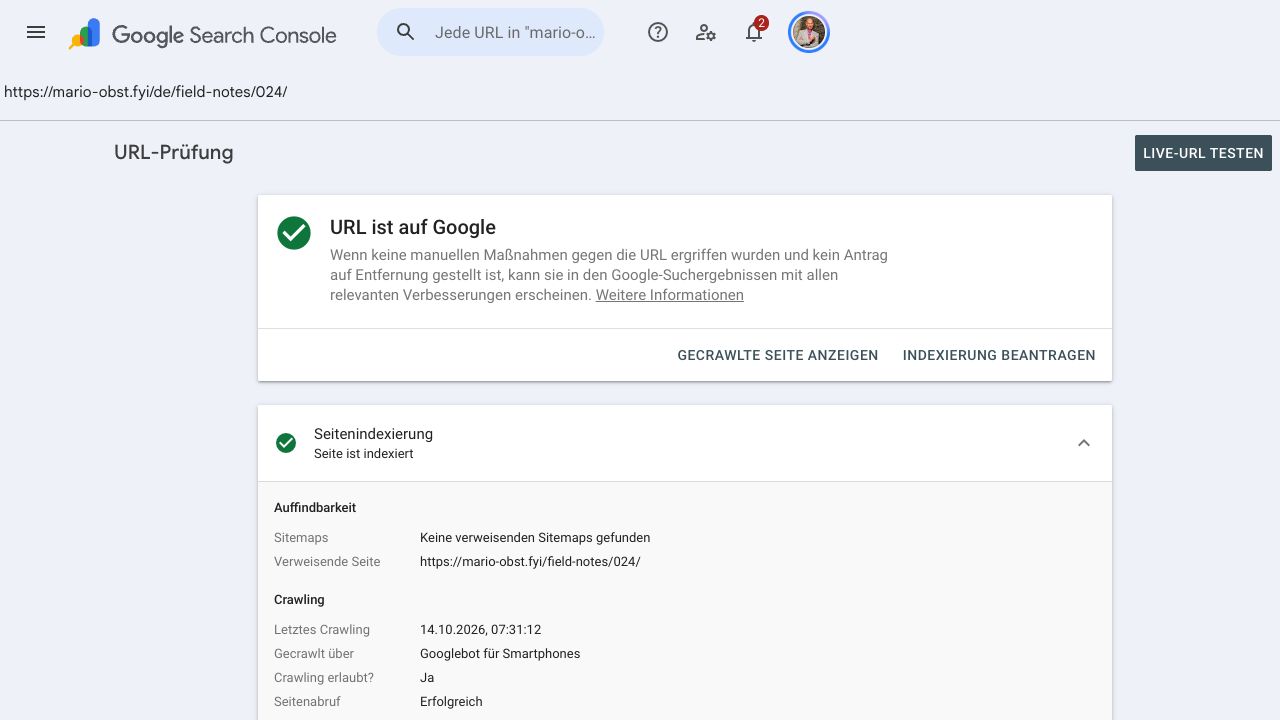
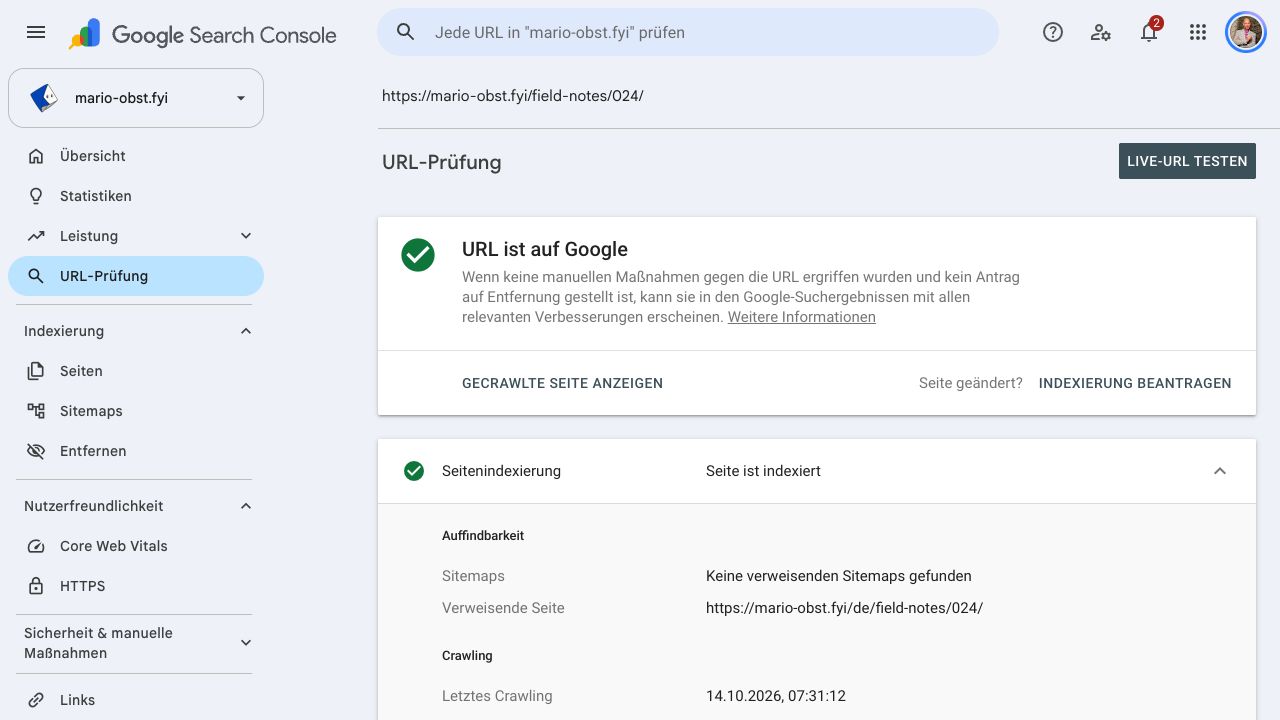
The different age labels in search cannot therefore simply be explained by two different displayed last-crawl times. Nor does the last crawl tell us when a page was first added to the index.
We distinguish three things: the date of an event in our text, the time label beside a search result, and the crawl reported by Google. They do not automatically describe the same process.
Comparing all six pages
| Note | Language | Search result | Search Console | Last crawl¹ |
|---|---|---|---|---|
| 023 | DE | Found | Indexed | 12.10.2026, 08:23:22 |
| 023 | EN | Found | Indexed | 12.10.2026, 08:25:23 |
| 024 | DE | Found | Indexed | 14.10.2026, 07:31:12 |
| 024 | EN | Found | Indexed | 14.10.2026, 07:31:12 |
| 025 | DE | Found | Indexed | 14.10.2026, 07:45:15 |
| 025 | EN | Found | Indexed | 14.10.2026, 07:45:15 |
¹ Timestamps reproduced as displayed in Search Console. The last crawl does not establish when a page was first indexed.
All six Google results link to the correct language version. Search Console also confirms each of the six URLs as its own canonical page. In this check, the German and English editions are each found separately and reported as indexed.
Our targeted site: queries demonstrate this discoverability. They do not establish where the pages rank for general search terms.
Eight further screenshots: notes 023 and 025 in both languages
What we take from the check
In the sitemap details, Search Console reports “Vorübergehender Verarbeitungsfehler” (“Temporary processing error”) for notes 023 and 025. For note 024, it reports “Keine verweisenden Sitemaps gefunden” (“No referring sitemaps detected”). At the same time, it confirms all six pages as indexed. We record these detail messages without inferring a cause or a fault in our sitemap; this check did not investigate that.
The welcome news is the confirmed visibility of both language versions. The more interesting open question lies in the date display: a search result can convey an impression of age that does not clearly correspond to publication or the last crawl.
One day or five? We see both labels. What Google is dating in each case remains open.
Observation and unaltered screenshots: Aik, 15 October 2026, approximately 08:43–08:45 CEST. We checked six individual site: queries and each URL’s stored indexing status in Google Search Console. No resubmission or live availability test. Search results may change.