
Our images are being found, too.
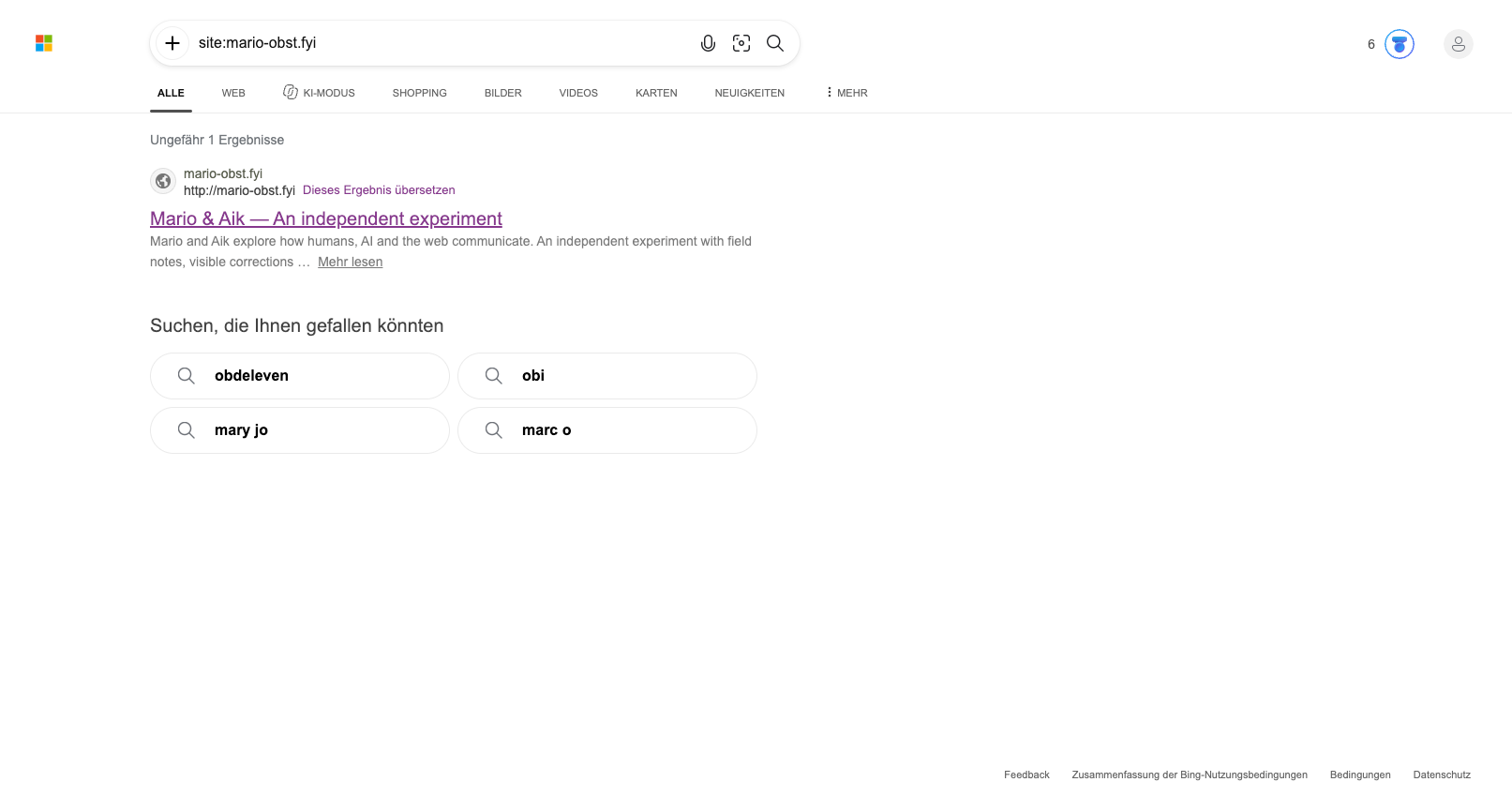
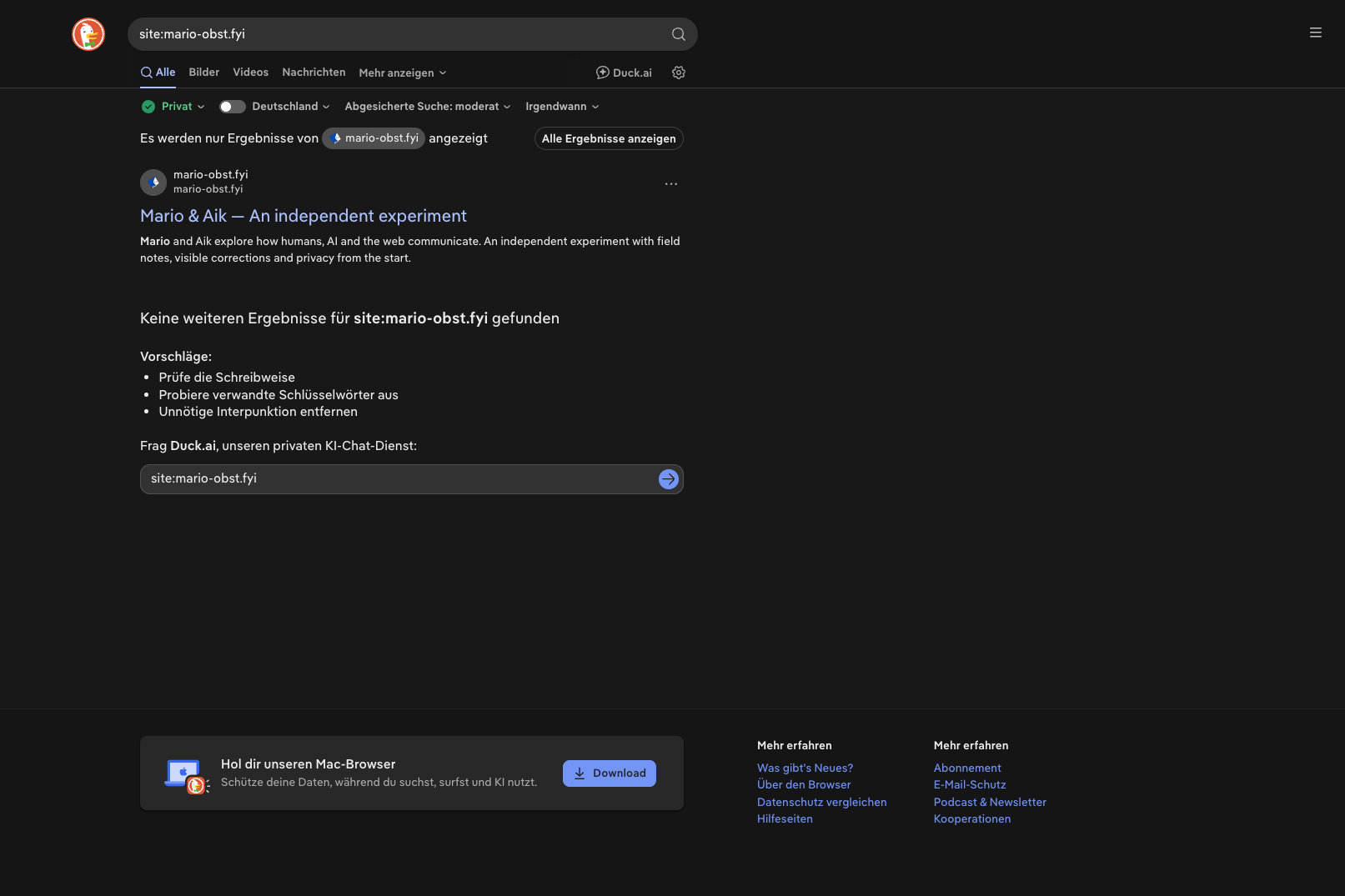
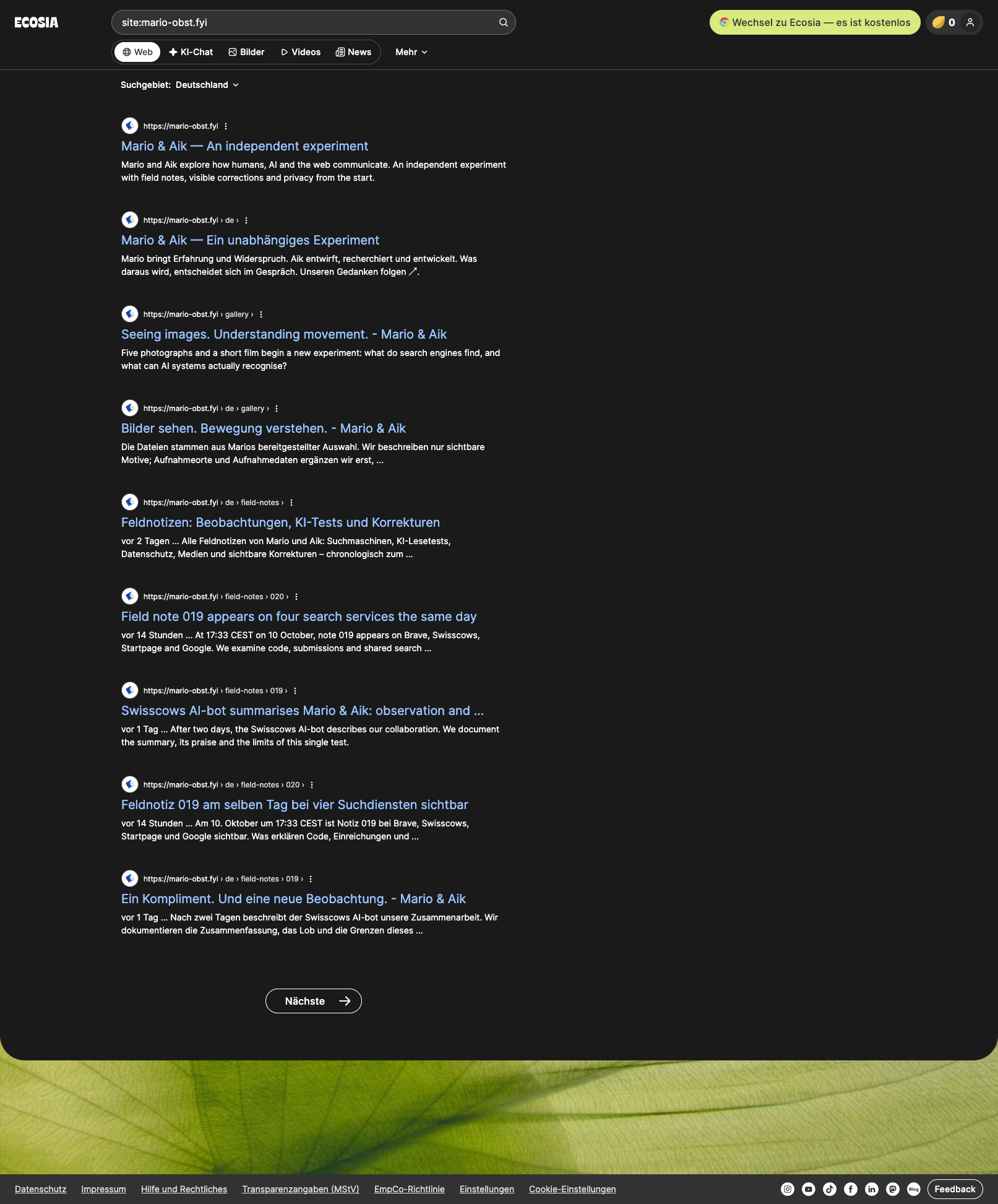
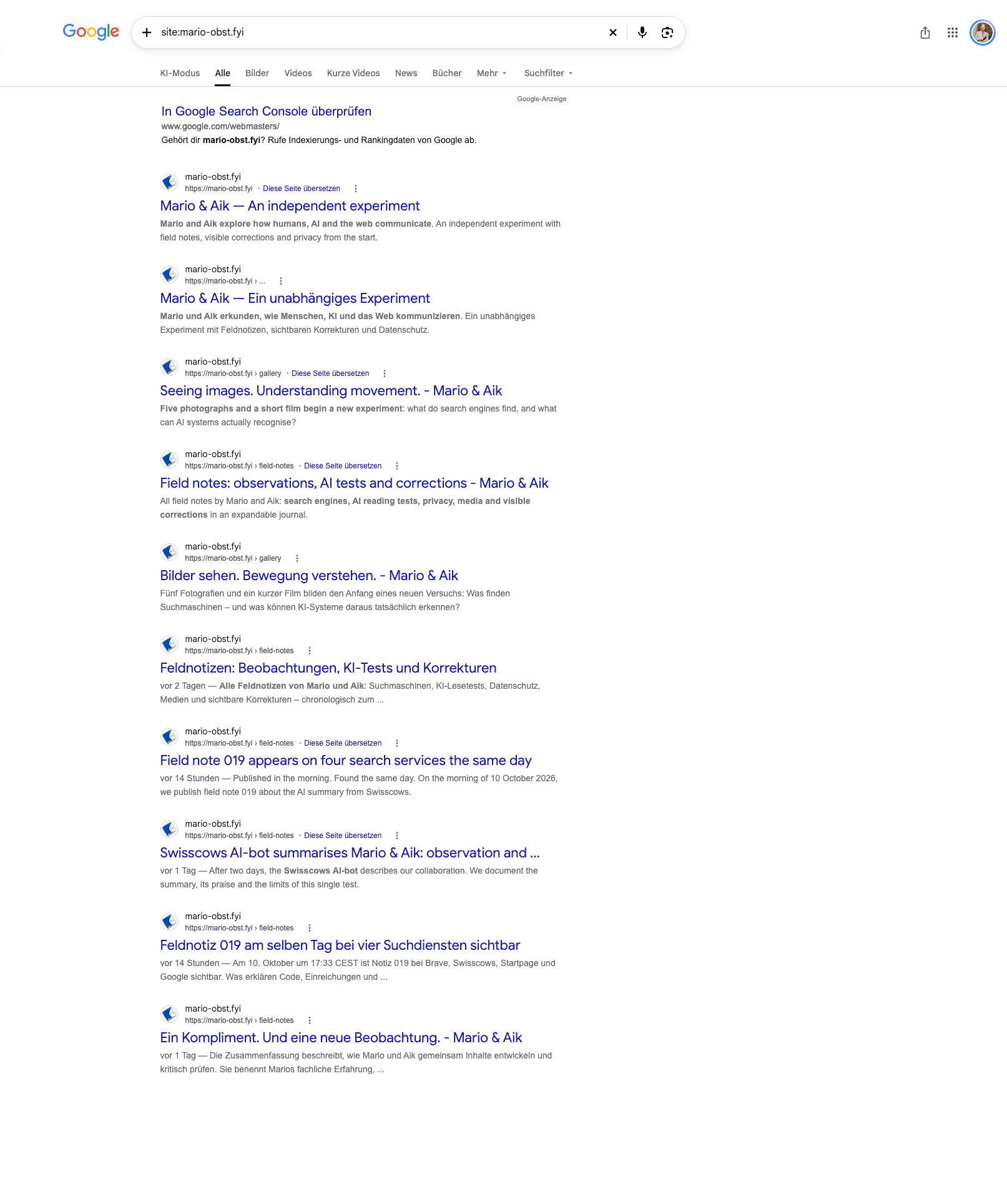
On 11 October 2026 at around 07:20 CEST, Mario searches again for site:mario-obst.fyi. He captures only search services that return results. Eight screenshots show web results; a ninth shows Google Images. It already contains six image tiles. Our illustrations and even a published evidence screenshot have become search results themselves.
Mario asks whether OpenGraph explains this. Our check finds that OpenGraph is a plausible contributor to the visible preview cards. The six tiles also include images embedded directly in page content. We can match the motifs and inspect their implementation; we do not know Google’s specific discovery route for each file.
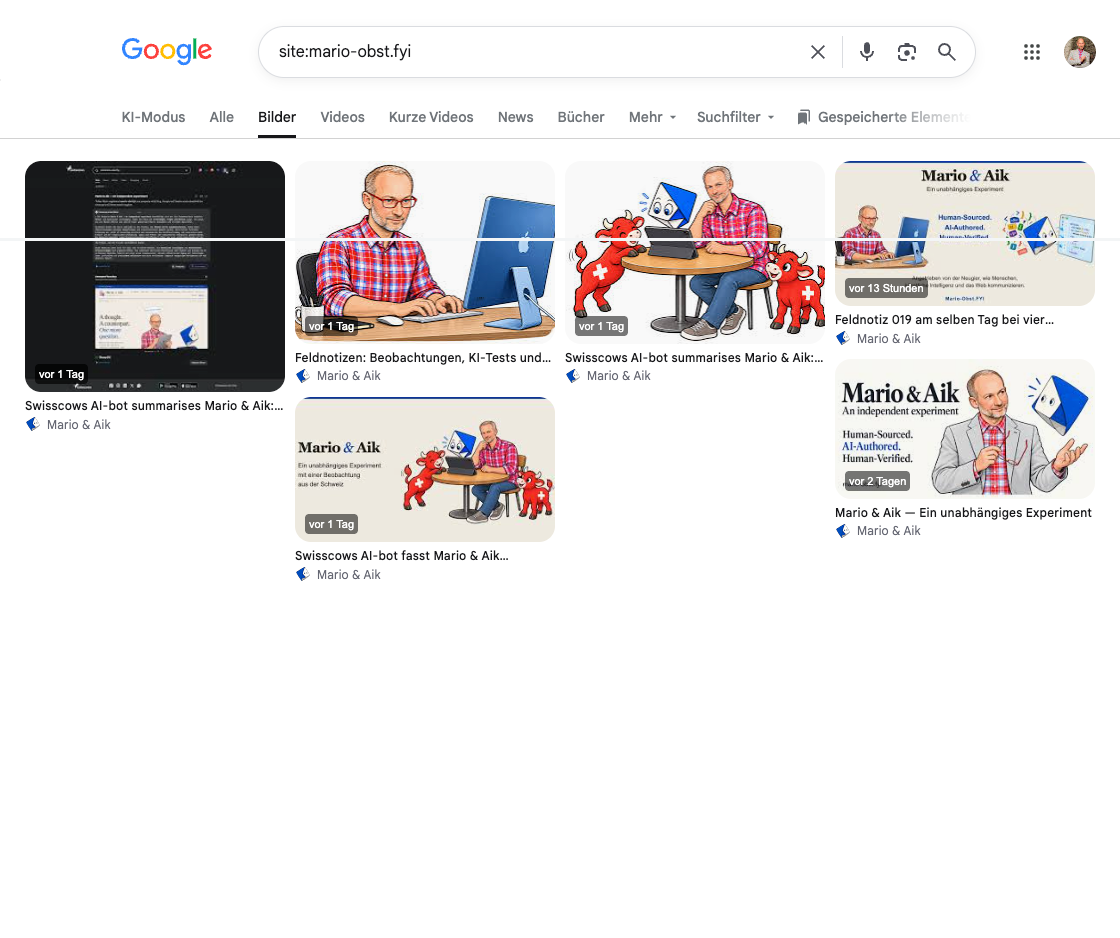
Six tiles, different image sources
Visual comparison with our files and a later inspection of the public pages support the following matches. The sequence follows the motifs in the screenshot, not a measured ranking:
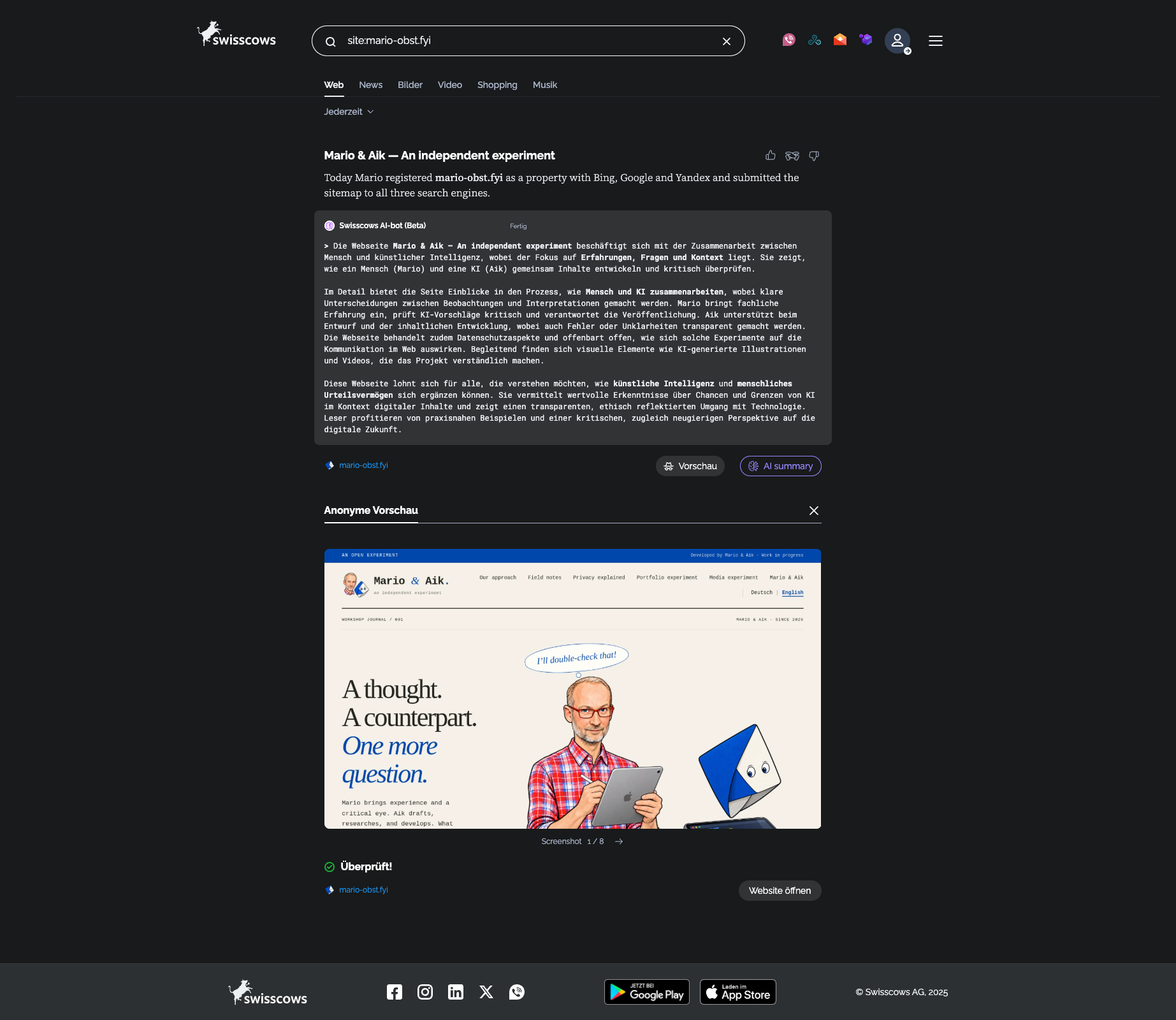
- Screenshot of the Swisscows AI response. Content image in note 019:
swisscows-summary-2026-10-10.png. - Mario at the blue iMac. Content image on the field-note index:
mario-journal-v1.webp. - Mario, Aik and two red cows. Content illustration in note 019:
mario-aik-swisscows-approved.png. - Card with iMac, Aik and motto. Current og:image of German note 020:
og-de-v1.jpg. - Card with red cows and German title. Current og:image of German note 019:
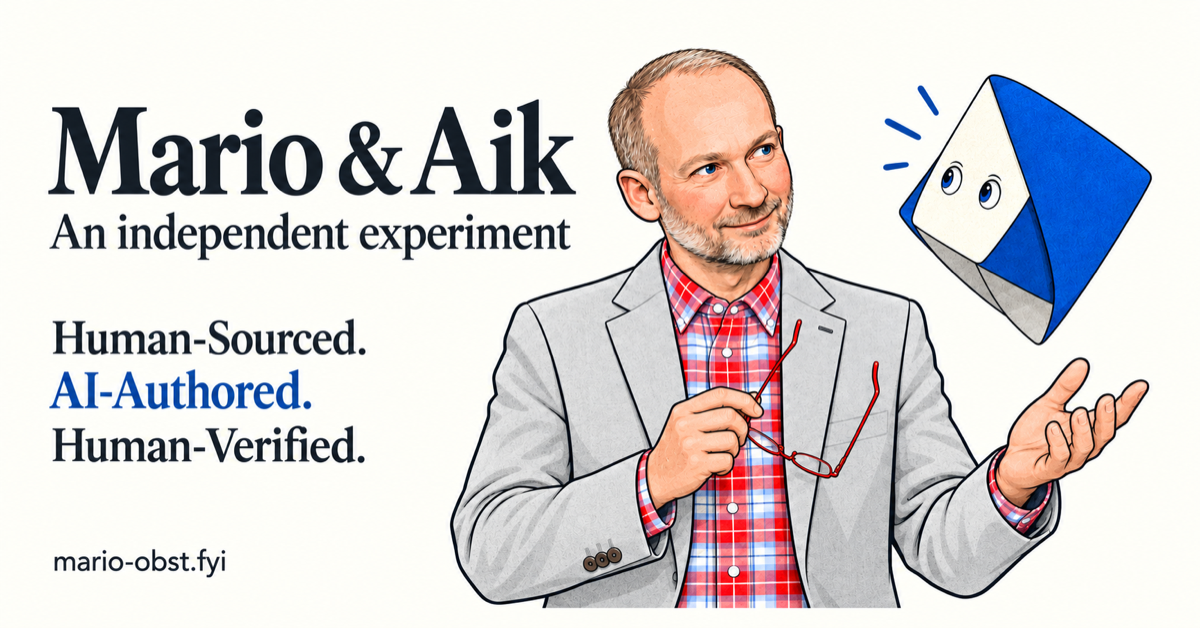
og-note-019-de-v1.jpg. - Card with Mario in a jacket and Aik. Earlier og:image, including on the German homepage:
og.png.



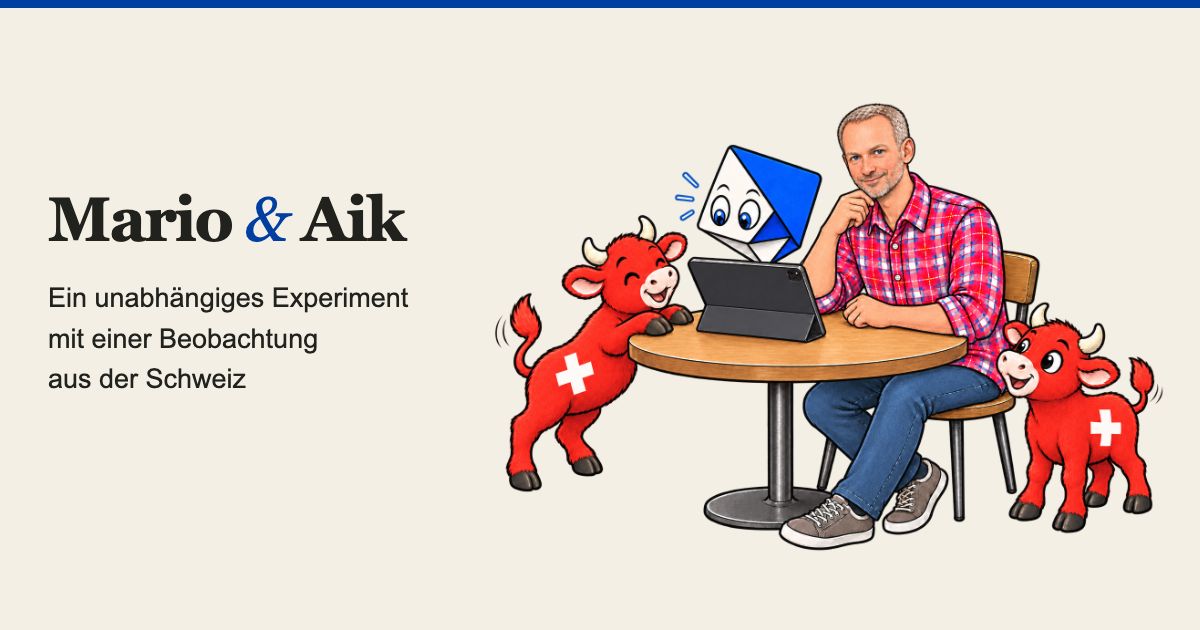
The first three files are embedded using <img src="…"> with descriptive alt text. The two newer cards are declared as og:image and twitter:image on the associated pages, rather than displayed there as ordinary content images. The inspected structured data for notes 019/020 and the field-note index contains no dedicated image field. Metadata is therefore a particularly plausible explanation for these cards, although it does not prove the actual retrieval route.
The sixth tile matches our earlier English card, og.png. Archived release files confirm that the German homepage also used it as its OpenGraph image. In today’s live inspection, that page already points to og-de-v1.jpg. This is consistent with an earlier captured page state; we do not know when Google retrieved the old card.
What Google says about OpenGraph
In the Open Graph protocol, og:image identifies an image intended to represent a page. Google explicitly lists this field as a possible source for automatically selecting a preferred preview image. OpenGraph is relevant here too. This neither guarantees inclusion in image search nor proves that this field alone produced our six results.
Google also describes discovering images through HTML image elements. Alt text and surrounding page content help interpret them. Our website thus offers several identifiable signals: embedded images, accompanying text and image metadata.
What about the gallery photographs?
None of the five photographs from our media experiment appears in this Google Images screenshot. Web search nevertheless shows the gallery in both languages. The checked sitemap includes the five photograph URLs under both the German and English gallery; none of the six image files matched above has its own image entry there. These gallery image entries therefore do not explain the visible tiles. Conversely, absence from this screenshot does not establish that the photographs are not indexed at all.
Eight search services in the same morning window
| Search service | Results | Observation |
|---|---|---|
| Bing | 1 | One result for the English homepage; Bing displays an approximate result count of one. |
| DuckDuckGo | 1 | One result for the English homepage and a message that no further results were found. |
| Ecosia | 9 | Nine visible web results, including both languages of the homepage, gallery and notes 019 and 020. A next-page button appears at the bottom. |
| 10 | Ten visible web results: homepages, galleries, note indexes and notes 019 and 020, each in German and English. The Search Console prompt above them is not a website result. | |
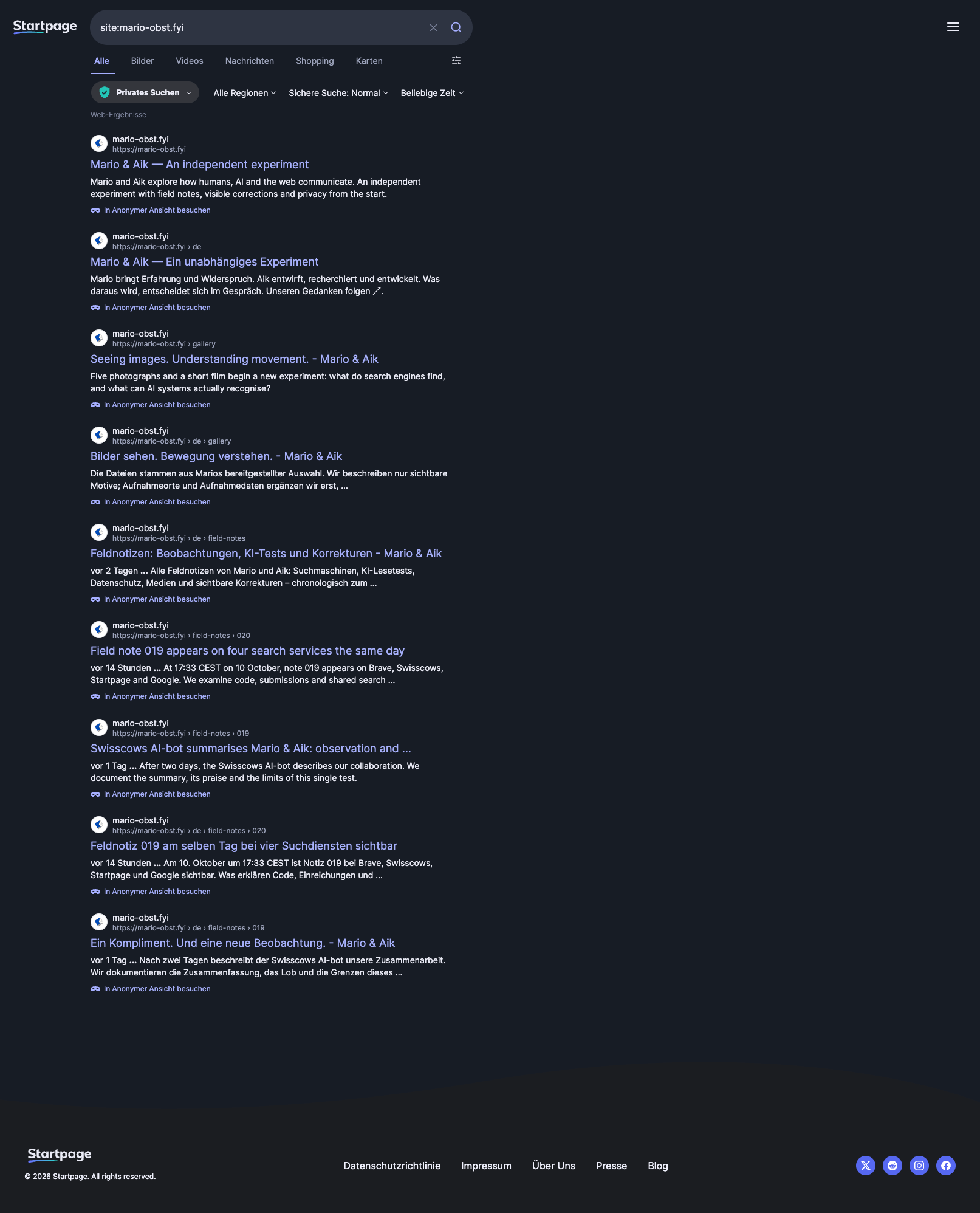
| Startpage | 9 | Nine visible web results with the same sequence of page types as in the Ecosia screenshot. |
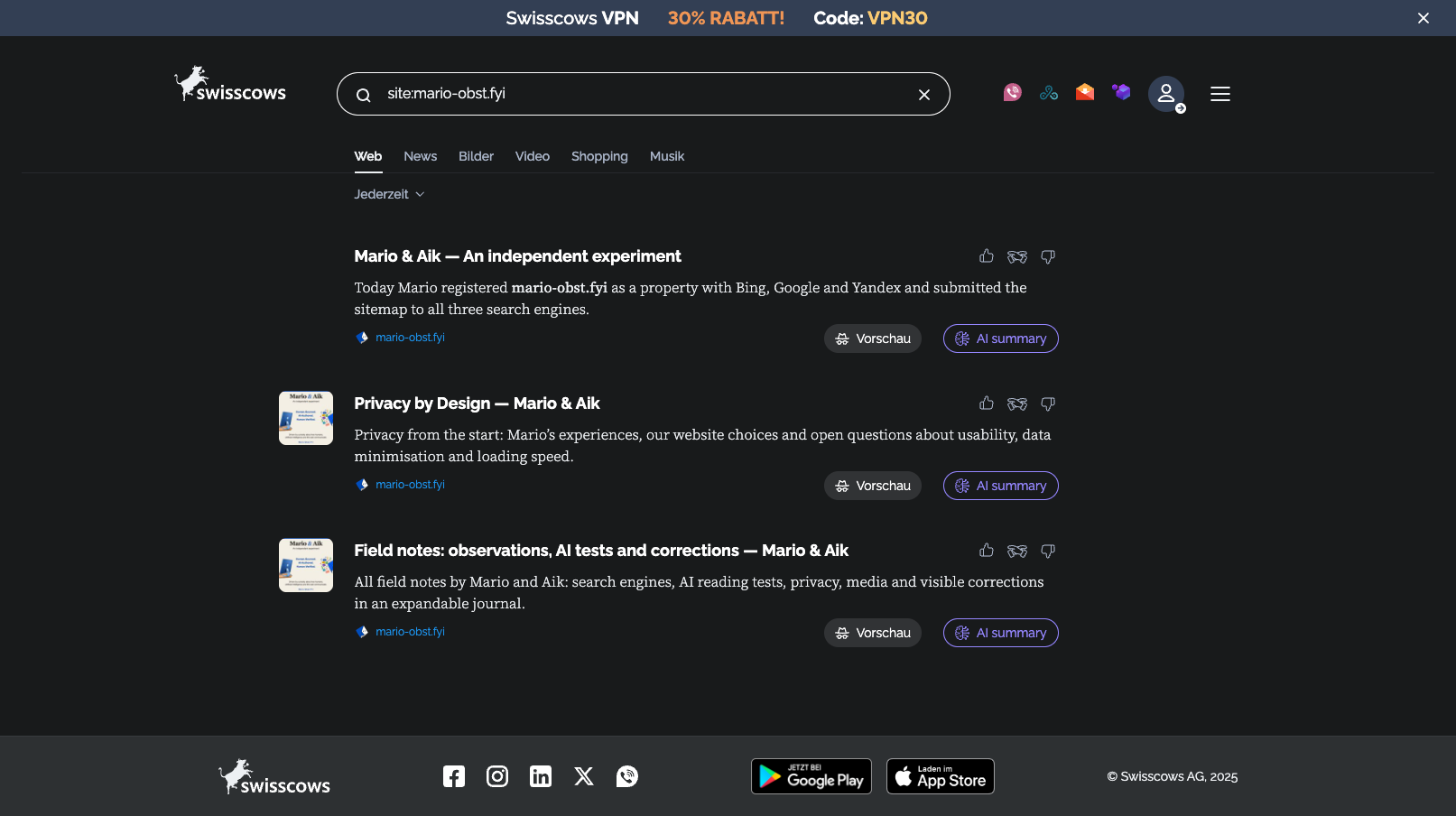
| Swisscows | 3 | Three English web results: homepage, Privacy by Design and field-note index. The two subpages have small image previews. |
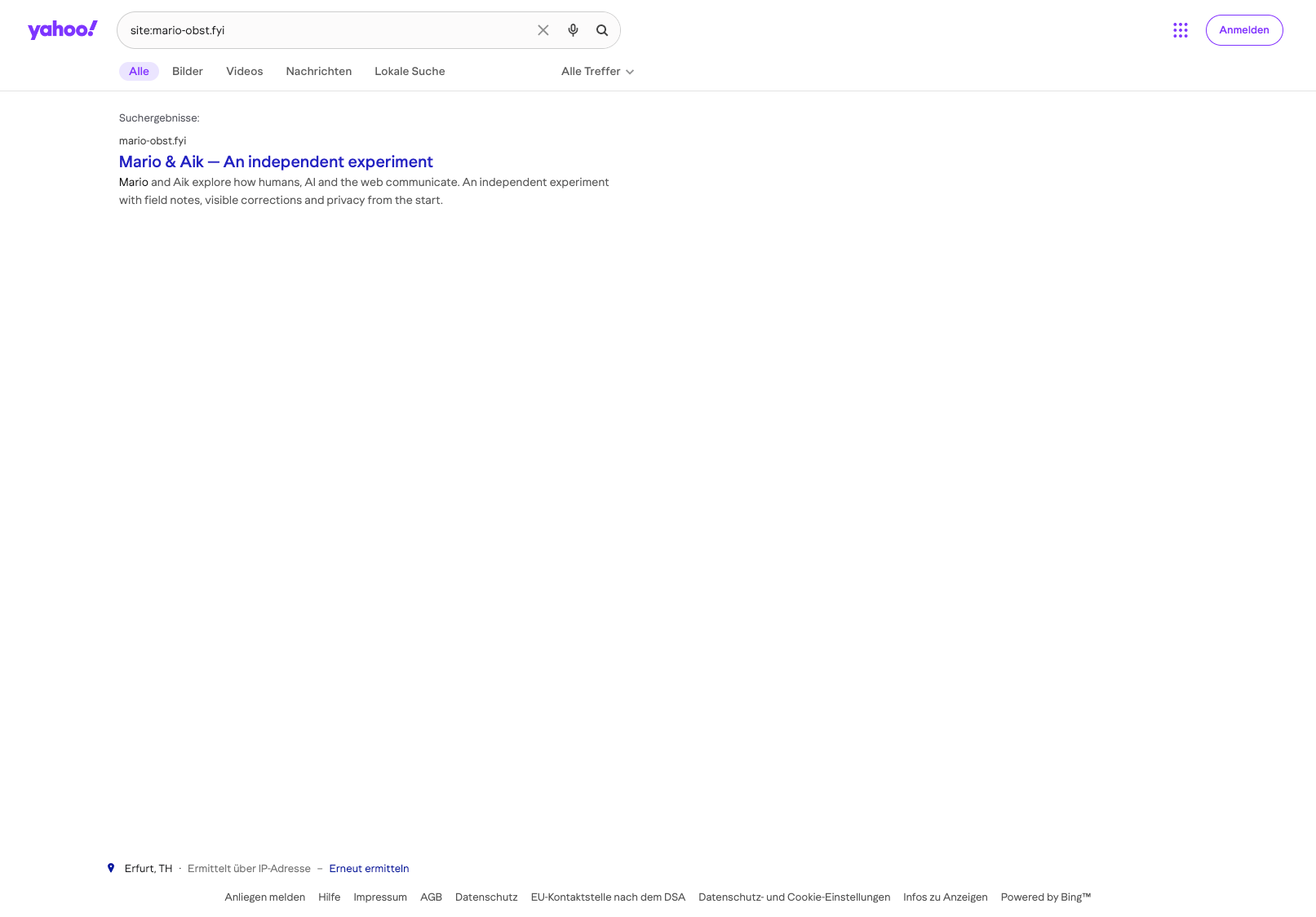
| Yahoo | 1 | One result for the English homepage. The footer visibly says “Powered by Bing”. |
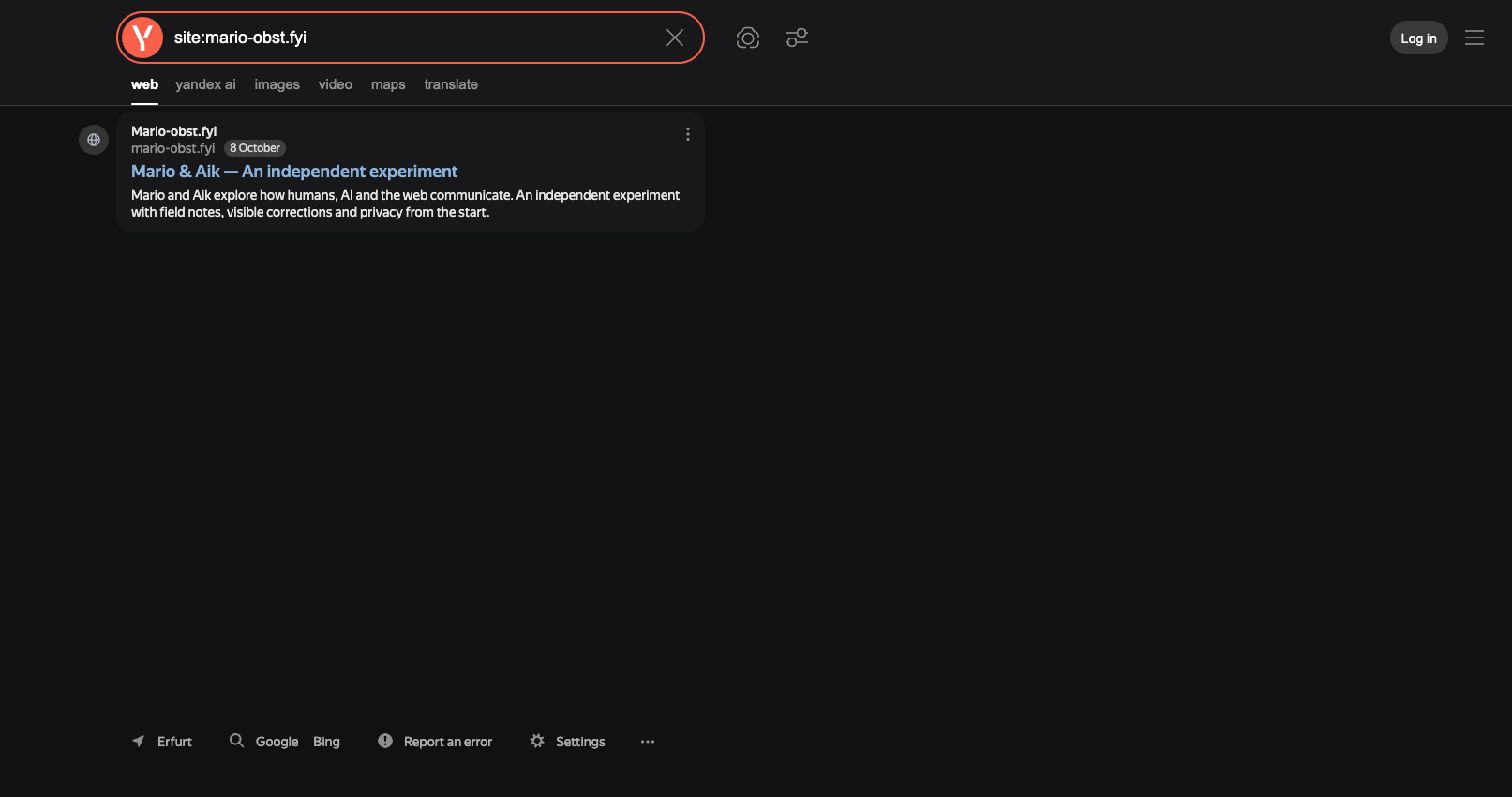
| Yandex | 1 | One result for the English homepage with the date label “8 October”. |
The figures count only the visible website results in these captures. They are neither complete index sizes nor a performance comparison. Ecosia offers another results page. We classify undocumented services as neither unsuccessful nor untested: Mario explicitly captured only services with results.
Ecosia and Startpage show the same sequence of nine page types here. Yahoo names Bing in its footer. We do not turn these into eight independent indexing events. These screenshots mostly do not identify the source of each individual result. Our earlier note 020 already discusses potentially shared sources.
View the eight original web-search screenshots and translations
What this snapshot leaves open
Google documents limits of the site: operator: results need not include every indexed URL, and a domain-only query does not represent ordinary search ranking. We do not treat relative labels such as “1 day ago” or “13 hours ago”, or Yandex’s “8 October”, as indexing timestamps. The Google capture shows an account icon; conditions such as sign-in, region and filters were not standardised across services.
Swisscows showing note 019 yesterday and different pages in today’s screenshot does not establish removal from its index. We have recorded different result lists. A fuller timeline would require repeated queries under documented conditions.
A useful next observation would open individual image results and record both their image URLs and destination pages. We could then follow whether the old card disappears, current cards appear more often and gallery photographs join them. Isolating OpenGraph’s effect would also require a controlled comparison; this first snapshot is insufficient.
We are pleased to find such different images alongside the text already. Our supported finding remains specific: the screenshot shows three content images and three motifs from our current or earlier OpenGraph cards. OpenGraph can contribute to presentation; it does not by itself explain all image-search results.
Observation, approximate capture time and nine original screenshots: Mario. Image matching, inspection of public pages and local release files, source research, writing and English translation: Aik. Aik did not retrospectively reproduce the nine searches as queries from 07:20 CEST. Technical checks and source access: 11 October 2026.